
IN THIS UNIT YOU WILL LEARN TO…
- say hello and welcome people in a French class or at work
- introduce yourself and ask someone's name
- spell your name aloud with the French alphabet
- say where you are from, your nationality and the languages you speak
- say what your job is
- choose correctly between tu and vous
Grammar: subject pronouns · the verb être · tu or vous · masculine and feminine nationalities and jobs · Pronunciation: silent final letters · the alphabet for spelling your name
1 · Dialogue · Dialogue
Montréal, a Monday morning in September. Kavya Mehta, a nurse from Pune, arrives for her first day of francisation, the French classes for adult newcomers in Québec. The teacher, Isabelle Roy, greets the class. Kavya sits next to Diego, a cook from Colombia.
Track 1A · Unit 1 · Recording A
Listen to the dialogue twice: first with the book closed, then reading along. Then play it a third time and repeat each line in the pause.
| Mme Roy | Bonjour à tous ! Je m'appelle Isabelle Roy. Je suis professeure de français. Bienvenue en francisation ! | Hello, everyone! My name is Isabelle Roy. I'm a French teacher. Welcome to the French class! |
| Kavya | Bonjour, madame. | Hello, madam. |
| Mme Roy | Bonjour ! Vous vous appelez comment ? | Hello! What's your name? |
| Kavya | Je m'appelle Kavya Mehta. | My name is Kavya Mehta. |
| Mme Roy | Kavya… Ça s'écrit comment ? | Kavya… How do you spell that? |
| Kavya | K-A-V-Y-A. | K-A-V-Y-A. |
| Mme Roy | Merci. Vous êtes indienne ? | Thank you. Are you Indian? |
| Kavya | Oui, je suis indienne. Je suis de Pune. | Yes, I'm Indian. I'm from Pune. |
| Mme Roy | Et vous êtes étudiante ? | And are you a student? |
| Kavya | Non, je suis infirmière. | No, I'm a nurse. |
| Mme Roy | Infirmière ! Super. Et vous, monsieur ? | A nurse! Great. And you, sir? |
| Diego | Bonjour ! Moi, c'est Diego Ramírez. | Hello! I'm Diego Ramírez. |
| Mme Roy | Enchantée, Diego. Vous êtes espagnol ? | Pleased to meet you, Diego. Are you Spanish? |
| Diego | Non, je suis colombien. Je suis de Bogotá. Et je suis cuisinier. | No, I'm Colombian. I'm from Bogotá. And I'm a cook. |
| Mme Roy | Cuisinier ? Excellent ! | A cook? Excellent! |
| Diego | Bonjour, Kavya. Enchanté ! Euh… on se dit tu ? | (to Kavya) Hi, Kavya. Pleased to meet you! Um… shall we say tu? |
| Kavya | Oui, d'accord ! Tu parles anglais, Diego ? | Yes, OK! Do you speak English, Diego? |
| Diego | Oui, je parle espagnol et anglais. Et toi ? | Yes, I speak Spanish and English. And you? |
| Kavya | Je parle marathi, hindi et anglais. Et un peu français ! | I speak Marathi, Hindi and English. And a little French! |
| Diego | Un peu ? Moi aussi ! | A little? Me too! |
| Mme Roy | Ici, on parle français, s'il vous plaît ! Ah, bonjour, madame. Bienvenue ! Entrez, entrez ! | (smiling) Here, we speak French, please! (someone knocks) Ah, hello, madam. Welcome! Come in, come in! |
FLC TIP
Mme Roy says Enchantée (she is a woman); Diego says Enchanté (he is a man). They sound the same. In French, many words change when the person is a woman: you will see this pattern all through the unit.
Exercise 1 Vrai ou faux ?
Read the dialogue again. Are these sentences true (vrai, V) or false (faux, F)? Correct the false ones in French.
1 Mme Roy est professeure de français.
- V
- F
2 Kavya est de Pune.
- V
- F
3 Kavya est médecin.
- V
- F
4 Diego est espagnol.
- V
- F
5 Diego est cuisinier.
- V
- F
6 Diego parle espagnol et anglais.
- V
- F
7 Kavya parle mandarin.
- V
- F
2 · Vocabulary · Vocabulaire
Learn each word with its gender and pronunciation. In the Say it column, capital N means a nasal sound (Unit 0). m = masculine, f = feminine.
Track 1B · Unit 1 · Recording B
Listen and repeat each word in the pause. The first part of the recording is the vocabulary below; the second part is the pronunciation practice in section 4.
2.1 · Meeting people
| Français | Say it | English |
|---|---|---|
| Je m'appelle… | zhuh ma-pehl | My name is… |
| Vous vous appelez comment ? | voo voo-za-play ko-mahN | What's your name? (polite, or to several people) |
| Tu t'appelles comment ? | tü ta-pehl ko-mahN | What's your name? (informal) |
| Moi, c'est… | mwa seh | I'm… (relaxed way to give your name) |
| Enchanté / Enchantée | ahN-shahN-tay | Pleased to meet you (said by a man / by a woman) |
| Bienvenue ! | byaN-vuh-nü | Welcome! |
| Ça s'écrit comment ? | sa say-kree ko-mahN | How do you spell that? (literally: How is that written?) |
| On se dit tu ? | ohN suh dee tü | Shall we say tu to each other? |
| la francisationf | la frahN-see-za-syohN | French classes for adult newcomers (Québec) |
2.2 · Countries and nationalities
| Français | Say it | English |
|---|---|---|
| le Canadam | luh ka-na-da | Canada |
| l'Indef | laNd | India |
| la Chinef | la sheen | China |
| la Colombief | la ko-lohN-bee | Colombia |
| la Francef | la frahNs | France |
| canadien / canadienne | ka-na-dyaN / ka-na-dyehn | Canadian |
| québécois / québécoise | kay-bay-kwa / kay-bay-kwaz | from Québec |
| indien / indienne | aN-dyaN / aN-dyehn | Indian |
| chinois / chinoise | shee-nwa / shee-nwaz | Chinese |
| colombien / colombienne | ko-lohN-byaN / ko-lohN-byehn | Colombian |
| français / française | frahN-seh / frahN-sehz | French |
| espagnol / espagnole | ehs-pa-nyol | Spanish |
2.3 · Languages
| Français | Say it | English |
|---|---|---|
| le françaism | luh frahN-seh | French (the language) |
| l'anglaism | lahN-gleh | English |
| l'hindim | leen-dee | Hindi |
| le marathim | luh ma-ra-tee | Marathi |
| le pendjabim | luh pehn-dja-bee | Punjabi |
| l'espagnolm | lehs-pa-nyol | Spanish |
| le mandarinm | luh mahN-da-raN | Mandarin Chinese |
| je parle / tu parles / vous parlez | zhuh parl / tü parl / voo par-lay | I speak / you speak (informal) / you speak (polite) |
RULE
All languages are masculine and take a small letter: le français, l'anglais, l'hindi. After parler (to speak) you usually drop le: Je parle hindi. Tu parles anglais ?
2.4 · Jobs
| Français | Say it | English |
|---|---|---|
| infirmier / infirmière | aN-feer-myay / aN-feer-myehr | nurse |
| médecin | mayd-saN | doctor |
| cuisinier / cuisinière | kwee-zee-nyay / kwee-zee-nyehr | cook |
| serveur / serveuse | sehr-vur / sehr-vuhz | waiter / waitress, server |
| vendeur / vendeuse | vahN-dur / vahN-duhz | salesperson, shop assistant |
| comptable | kohN-tabl | accountant |
| développeur / développeuse | day-vlo-pur / day-vlo-puhz | (software) developer |
| ingénieur / ingénieure | aN-zhay-nyur | engineer |
| professeur / professeure | pro-feh-sur | teacher, professor |
| étudiant / étudiante | ay-tü-dyahN / ay-tü-dyahNt | student |
2.5 · Small but useful words
| Français | Say it | English |
|---|---|---|
| et | ay | and |
| mais | meh | but |
| aussi | oh-see | also, too |
| ici | ee-see | here |
| très bien | treh byaN | very good, very well |
| d'accord | da-kor | OK, agreed |
USEFUL PHRASES
- Bonjour à tous ! — Hello, everyone!
- Je suis de Pune. — I'm from Pune. (être de + city = to be from)
- Il s'appelle Diego. Elle s'appelle Mei Lin. — His name is Diego. Her name is Mei Lin.
- Et vous ? / Et toi ? — And you? (polite / informal)
- Moi aussi ! — Me too!
- un peu — a little: Je parle un peu français.
- Pardon ? Je ne comprends pas. — Sorry? I don't understand. (from Unit 0)
Exercise 2 Where are they from?
Complete each sentence with a nationality from 2.2. Be careful: a woman needs the feminine form.
- Kavya est de Pune. Elle est .
- Diego est de Bogotá. Il est .
- Li Wei est de Pékin. Il est .
- Paul est de Toronto. Il est .
- Camille est de Paris. Elle est .
- Arjun est de Pune. Il est .
- Carmen est de Madrid. Elle est .
- Julie est de Québec. Elle est .
Exercise 3 Who does what?
Match each job (1–8) with the right description (a–h).
| 1 infirmière | a serves food in a restaurant |
| 2 cuisinier | b studies at a school or a university |
| 3 comptable | c sells things in a shop |
| 4 développeuse | d cares for patients in a hospital |
| 5 serveur | e prepares food in a kitchen |
| 6 vendeuse | f checks accounts and taxes |
| 7 étudiant | g writes computer programs |
| 8 professeure | h teaches a class |
Exercise 4 What do you say?
Choose the best answer for each situation.
1 You meet your French teacher for the first time. You say:
- Salut, Isabelle !
- Bonjour, madame.
- Moi aussi !
- Ça s'écrit comment ?
2 A classmate says: « Je m'appelle Ana. » You answer:
- Enchanté ! / Enchantée !
- Au revoir !
- Je suis de Pune.
- Un peu.
3 You heard a name but you don't know how to write it. You ask:
- Vous vous appelez comment ?
- Vous parlez anglais ?
- Ça s'écrit comment ?
- Vous êtes étudiant ?
4 You get on well with a classmate and want to switch to tu. You ask:
- Bienvenue en francisation !
- On se dit tu ?
- Vous êtes infirmière ?
- Moi, c'est Kavya.
5 Mme Roy asks Kavya: « Vous parlez anglais ? » Kavya says:
- Oui, je suis anglaise.
- Oui, tu parles anglais.
- Oui, je parle anglais.
- Oui, il parle anglais.
3 · Grammar · Grammaire
3.1 · Subject pronouns (je, tu, il, elle…)
What they are. Subject pronouns tell you who does something: I, you, he, she, we, they. As in English, almost every verb needs one.
| French | Say it | English | When to use it |
|---|---|---|---|
| je (j' before a vowel) | zhuh | I | no capital letter except at the start of a sentence |
| tu | tü | you | one friend, child or family member (3.3) |
| il | eel | he, it | a man or boy (and masculine things) |
| elle | ehl | she, it | a woman or girl (and feminine things) |
| on | ohN | we (informal); people in general | very common in speech |
| nous | noo | we | more formal, and in writing |
| vous | voo | you | one person politely, or two or more people (3.3) |
| ils | eel | they | a group of men, or a mixed group of men and women |
| elles | ehl | they | a group of women only |
- Diego ? Il est colombien. — Diego? He's Colombian.
- Julie ? Elle est infirmière. — Julie? She's a nurse.
- Ici, on parle français. — Here, we speak French.
- Kavya et Mei Lin ? Elles sont en classe. — Kavya and Mei Lin? They're in class.
- Kavya et Diego ? Ils sont en classe. — Kavya and Diego? They're in class.
RULE
il and ils sound the same, and so do elle and elles: the final -s is silent. You hear the difference in the verb (il est / ils sont), not in the pronoun.
ATTENTION !
One man in a group is enough to make it ils. Ten women and one man? Still ils. Use elles only when everyone in the group is female.
Kavya, Mei Lin et Diego ? Elles sont en classe. → Ils sont en classe.
FLC TIP
On is everywhere in spoken French, in Canada as in France: On est à Montréal = Nous sommes à Montréal, but more relaxed. Use nous in formal writing. With on, the verb takes the il/elle form.
Exercise 5 Who is it?
Write the subject pronoun that can replace the words in bold.
- Kavya est infirmière. → est infirmière.
- Diego est cuisinier. → est cuisinier.
- Camille et Carmen sont étudiantes. → sont étudiantes.
- Paul et Marc sont étudiants. → sont étudiants.
- Kavya et Diego sont en classe. → sont en classe.
- Mme Roy est québécoise. → est québécoise.
- Arjun says: « Kavya et moi, sommes de Pune. »
- Mme Roy says to Diego and Ana: « Diego et Ana, êtes étudiants ici. »
3.2 · The verb être (to be)
What it is. Être ("to be") is the most important French verb. Like "to be" in English, it is irregular, so learn each form by heart. Use it for your nationality, your job and where you are from.
| être · to be · présent | |||
|---|---|---|---|
| je | suis | zhuh swee | I am |
| tu | es | tü eh | you are (informal) |
| il / elle / on | est | eel eh / ehl eh / ohN-neh | he is / she is / we are, people are |
| nous | sommes | noo som | we are |
| vous | êtes | voo-zeht | you are (polite or plural) |
| ils / elles | sont | eel sohN / ehl sohN | they are |
- Je suis infirmière. — I'm a nurse.
- Tu es de Bogotá ? — Are you from Bogotá?
- Mme Roy est québécoise. — Mme Roy is from Québec.
- On est en classe ! — We're in class!
- Nous sommes à Montréal. — We are in Montréal.
- Vous êtes professeure, madame ? — Are you a teacher, madam?
- Paul et Marc sont étudiants. — Paul and Marc are students.
- Moi, c'est Diego. — I'm Diego. (c'est = ce + est, "it is / this is")
FLC TIP
Hindi "to be" also changes with the person: main hoon, tum ho, aap hain, voh hai. French does the same: je suis, tu es, vous êtes, il est. Say the six forms aloud every day like a little song until they are automatic.
RULE
Yes/no questions. Take a normal sentence and make your voice go up at the end: Vous êtes indienne. (statement, voice goes down) → Vous êtes indienne ? (question, voice goes up). Answer Oui or Non. Unit 3 shows other ways to ask.
RULE
Liaison in vous êtes. The silent -s of vous is pronounced as a z when the next word starts with a vowel: vous êtes = [voo-zeht]. Never say "voo et". In the same way, on est = [ohN-neh].
ATTENTION !
Three mistakes Indian learners often make with être:
Je indienne.→ Je suis indienne. (French never drops the verb.)Je suis Pune.→ Je suis de Pune. (Use de for "from".)Je suis 30 ans.→ J'ai 30 ans. (Age uses the verb avoir, "to have". You will learn it in Unit 2.)
Exercise 6 The right form of être
Complete with suis, es, est, sommes, êtes or sont.
- Je de Pune.
- Diego, tu colombien ?
- Mme Roy québécoise.
- Nous en classe.
- Madame, vous professeure ?
- Kavya et Mei Lin en classe.
- Paul ingénieur.
- Ici, on à Montréal !
- Kavya et Arjun indiens.
- Moi, je infirmière.
Exercise 7 Put the words in order
Write a correct sentence. Start with a capital letter and end with a period or a question mark.
- infirmière / je / suis
- colombien / est / Diego
- québécoise / vous / êtes / ?
- Pune / sommes / nous / de
- appelle / Mei Lin / je / m'
- sont / étudiants / ici / ils
3.3 · Tu or vous?
What it is. English has one "you"; French has two: tu (informal) and vous (polite). Choosing well shows respect. Vous is also the only "you" for two or more people, even friends.
| Use tu with… | Use vous with… |
|---|---|
| a friend, a classmate who suggests it | a person you meet for the first time |
| your husband, wife, family | an older person |
| a child | your teacher (at least at first) |
| a colleague, when they use tu with you | a receptionist, a doctor, a shop assistant, an official |
| a pet! | two or more people (always) |
The pronoun changes the verb and several little phrases around it:
| With vous (polite) | With tu (informal) | English |
|---|---|---|
| Bonjour ! | Salut ! / Bonjour ! | Hello! / Hi! |
| Vous vous appelez comment ? | Tu t'appelles comment ? | What's your name? |
| Vous êtes indienne ? | Tu es indienne ? | Are you Indian? |
| Vous parlez anglais ? | Tu parles anglais ? | Do you speak English? |
| Et vous ? | Et toi ? | And you? |
| Au revoir ! | Salut ! / Au revoir ! | Goodbye! / Bye! |
FLC TIP
Think of Hindi: vous is like aap and tu is like tum. Just as you would not say tum to your boss's mother, do not say tu to Mme Roy on the first day. When you are not sure, choose vous. Nobody is offended by vous; the other person will tell you if they prefer tu.
RULE
Polite vous takes the plural verb (vous êtes), but if you are speaking to one person, the nationality or job stays singular: Madame, vous êtes québécoise ? (one woman). Madame, monsieur, vous êtes québécois ? (two people: plural, and québécois already ends in -s).
⚜ AU QUÉBEC
Quebecers switch to tu faster than people in France: colleagues and young people may say tu on day one. On se dit tu ? is very common, and the answer is usually Oui, d'accord ! Still, start with vous with older people, officials and your teacher.
Exercise 8 Tu or vous?
You are speaking to these people. Write tu or vous.
- a six-year-old school friend of your daughter
- the receptionist at the francisation centre
- Mme Roy, on the first day of class
- Diego, after he says « On se dit tu ? »
- Diego and Mei Lin together
- an older neighbour you meet for the first time
- your husband or wife
- a pharmacist you don't know
Exercise 9 From vous to tu
Diego asks Kavya some questions with vous. Then they decide to say tu. Rewrite each line with tu.
- Vous vous appelez comment ?
- Vous êtes indienne ?
- Vous parlez anglais ?
- Bonjour ! Et vous ?
- Vous êtes de Pune ?
- Enchanté ! Vous êtes étudiante ?
3.4 · Nationalities and jobs: masculine and feminine
What it is. A nationality or job changes its ending to match the person: a man is indien, a woman indienne. Hindi does something similar (accha ladka, acchi ladki), so only the endings are new.
| Pattern | Masculine | Feminine | What you hear |
|---|---|---|---|
| add -e | français, chinois, espagnol, étudiant | française, chinoise, espagnole, étudiante | a final consonant appears: [frahN-seh / frahN-sehz] (but espagnol sounds the same) |
| -ien → -ienne | indien, canadien, colombien | indienne, canadienne, colombienne | nasal → not nasal: [aN-dyaN / aN-dyehn] |
| -ier → -ière | infirmier, cuisinier | infirmière, cuisinière | [aN-feer-myay / aN-feer-myehr] |
| -eur → -euse | serveur, vendeur, développeur | serveuse, vendeuse, développeuse | [sehr-vur / sehr-vuhz] |
| no change | comptable, médecin | comptable, médecin | same word: Elle est médecin. |
| add -e (Canadian usage) | professeur, ingénieur | professeure, ingénieure | spelling changes, the sound does not |
- Diego est colombien. Carmen est espagnole. — Diego is Colombian. Carmen is Spanish.
- Arjun est indien. Kavya est indienne. — Arjun is Indian. Kavya is Indian.
- Il est cuisinier. Elle est cuisinière. — He's a cook. She's a cook.
- Camille est comptable. Paul est ingénieur. — Camille is an accountant. Paul is an engineer.
- Mme Roy est professeure. — Mme Roy is a teacher.
Plural. For two or more people, add -s. It is silent. A word that already ends in -s does not change. A mixed group takes the masculine form.
- Ils sont canadiens. Elles sont indiennes. — They're Canadian. They're Indian (all women).
- Ils sont français. Ils sont chinois. — They're French. They're Chinese. (no extra -s)
- Paul et Camille sont étudiants. — Paul and Camille are students. (mixed group → masculine)
RULE
No article for jobs after être. English says "I'm a nurse". French says Je suis infirmière, with no word for "a". Good news: Hindi works like French here (main nurse hoon). The same is true for nationalities: Il est colombien.
One exception to remember: after c'est, a job needs un/une: C'est un cuisinier. (He's a cook.) For now, use il est / elle est + job.
ATTENTION !
1. No "a" with jobs: Je suis une infirmière. → Je suis infirmière. Il est un cuisinier. → Il est cuisinier.
2. Small letters: in English, nationalities and languages take a capital letter. In French, they do not: Je suis Indienne. Je parle Anglais. → Je suis indienne. Je parle anglais. Countries do take a capital: l'Inde, le Canada.
3. Agree with the person, not with yourself: when Kavya talks about Arjun, she says Il est indien, not Il est indienne.
Exercise 10 Make it feminine or plural
Rewrite each sentence, starting with the pronoun in brackets.
- Il est infirmier. (Elle)
- Il est canadien. (Elle)
- Il est vendeur. (Elle)
- Il est français. (Elle)
- Il est comptable. (Elle)
- Il est professeur. (Elle)
- Il est indien. (Elles)
- Il est étudiant. (Ils)
- Il est chinois. (Ils)
Exercise 11 Find the mistake
Each sentence has one mistake. Write the correct sentence.
- Je suis une infirmière.
- Elle est Indienne.
- Kavya est indien.
- Vous es professeure ?
- Paul et Camille sont étudiantes.
- Nous êtes de Pune.
- Il est un cuisinier.
- Diego parle Anglais.
4 · Pronunciation · Prononciation
Play the second part of Recording B and repeat everything in the order printed here.
4.1 · Silent final letters
Most final consonants are silent: -d, -g, -p, -s, -t, -x, -z. As in Unit 0, four are often pronounced: C, R, F, L (CaReFuL). But in the ending -er of verbs and of many job words (infirmier, cuisinier), the r is silent and -er sounds [ay].
| Silent | Pronounced (CaReFuL) | -er = [ay] |
| français [frahN-seh] | Québec [kay-behk] | infirmier [aN-feer-myay] |
| chinois [shee-nwa] | espagnol [ehs-pa-nyol] | cuisinier [kwee-zee-nyay] |
| étudiant [ay-tü-dyahN] | professeur [pro-feh-sur] | |
| vous [voo] | bonjour [bohN-zhoor] | |
| ils sont [eel sohN] | ||
| salut [sa-lü] |
FLC TIP
This explains 3.4: add the feminine -e and the consonant before it is no longer final, so you hear it (the -e stays silent). Repeat the pairs: français / française · chinois / chinoise · étudiant / étudiante · indien / indienne.
Exercise 12 Do you hear the last letter?
Listen to Recording B. Is the final consonant in bold pronounced (P) or silent (S)? Then check with the rules above.
- anglais
- Montréal
- comment
- d'accord
- mais
- développeur
- neuf
- deux
- et
- il
4.2 · The alphabet: spelling your name
In Canada you will spell your name constantly: at the bank, at the clinic, on the phone. Spell it slowly and clearly. Here are the French letter names.
| A [a] | B [bay] | C [say] | D [day] | E [uh] | F [ehf] | G [zhay] |
| H [ash] | I [ee] | J [zhee] | K [ka] | L [ehl] | M [ehm] | N [ehn] |
| O [oh] | P [pay] | Q [kü] | R [ehr] | S [ehs] | T [tay] | U [ü] |
| V [vay] | W [doo-bluh-vay] | X [eeks] | Y [ee-grehk] | Z [zehd] |
ATTENTION !
These letters trap English speakers every day:
- E = [uh] and I = [ee] — The English letter "E" sounds like the French I. Say Mehta: M-E-H-T-A, with [uh].
- G = [zhay] and J = [zhee] — The opposite of English! Practise: Gupta starts with [zhay], Joshi with [zhee].
- H = [ash], R = [ehr], U = [ü] — Not "aitch", "aar" or "you".
USEFUL PHRASES
- deux L, deux T — double L, double T (literally "two L")
- E accent aigu (é) · E accent grave (è) — e with an acute accent · e with a grave accent
- C cédille (ç) — c with a cedilla
- trait d'union (-) — hyphen
- Mehta : M-E-H-T-A. — Mehta: M-E-H-T-A.
Exercise 13 Listen and write the names
At the end of Recording B, six people spell their family names. Write each name.
Now spell your own name aloud, slowly. Record yourself and check every letter.
5 · Listening · Écouter
Later that morning, Mei Lin, the late student, introduces herself (Document 1). A new student, Rohan, registers (Document 2). At the break, Mei Lin and Rohan chat about Ana, another student in the class (Document 3).
Track 1C · Unit 1 · Recording C
Read the questions first. Then listen to each document twice before you answer.
FLC TIP
You do not need every word. Underline the key words in the questions (a city, a job, a language) and listen for them. This is how you will work in the TEF Canada listening test later.
Exercise 14 Document 1 · Mei Lin
Listen. Vrai (V) ou faux (F) ?
1 Mei Lin est de Pékin.
- V
- F
2 Mei Lin est médecin.
- V
- F
3 Mei Lin parle anglais.
- V
- F
4 Mei Lin parle un peu français.
- V
- F
5 Mme Roy est de Montréal.
- V
- F
Exercise 15 Document 2 · Rohan registers
Listen and complete Rohan's registration form.
Fiche d'inscription · Francisation
| Prénom | Rohan |
| Nom | (1) |
| Nationalité | indien |
| Ville | (2) |
| Profession | (3) |
| Langues | (4) , (5) et anglais |
une fiche d'inscription a registration form
le prénom first name
le nom family name, last name
la ville city, town
la nationalité nationality
la langue language
Exercise 16 Document 3 · At the break
Listen and choose the right answer.
1 Ici, à Montréal, Rohan est…
- ingénieur.
- étudiant.
- professeur.
- comptable.
2 Nationalité d'Ana :
- espagnole
- colombienne
- brésilienne
- chinoise
3 Profession d'Ana :
- cuisinière
- comptable
- vendeuse
- serveuse
brésilien / brésilienne Brazilian
6 · Reading · Lire
On Friday, Mme Roy asks each student to write a short card about themselves. She pins the cards on the classroom wall under the title « Qui est qui ? » (Who's who?).
Qui est qui ? · La classe de Mme Roy
Kavya · Bonjour ! Je m'appelle Kavya Mehta. Je suis indienne, de Pune. Je suis infirmière. Je parle marathi, hindi et anglais. Et un peu français !
Diego · Salut ! Moi, c'est Diego. Je suis colombien, de Bogotá. Je suis cuisinier. Je parle espagnol et anglais. Le français ? Un peu !
Mei Lin · Bonjour à tous ! Je m'appelle Mei Lin. Je suis chinoise, de Shanghai. Je suis comptable. Je parle mandarin et anglais.
Rohan · Bonjour ! Je m'appelle Rohan Dhillon. Je suis indien, de Ludhiana. Je suis ingénieur, mais ici, je suis étudiant ! Je parle pendjabi, hindi et anglais.
Ana · Bonjour ! Je m'appelle Ana Souza. Je suis brésilienne, de São Paulo. Je suis serveuse. Je parle portugais, espagnol et anglais.
brésilien / brésilienne Brazilian
le portugais Portuguese (the language)
Exercise 17 Qui… ?
Read the cards. Write the name of the right person. There is only one answer each time.
- Qui est comptable ?
- Qui est de Bogotá ?
- Qui parle portugais ?
- Qui parle marathi ?
- Qui est ingénieur ?
- Qui est infirmière ?
- Qui est de Shanghai ?
- Qui est cuisinier ?
Exercise 18 Translate a card
Translate Diego's and Rohan's cards into natural English. (English needs "a" before a job.)
7 · Writing · Écrire
Study the model first. Arjun, Kavya's husband, writes a card for the newcomers' board at a Montréal welcome centre.
MODEL ANSWER
Bonjour à tous ! Je m'appelle Arjun Mehta. Je suis indien. Je suis de Pune, en Inde. Je suis développeur. Je parle marathi, hindi et anglais. Et le français ? Un peu ! Ici, à Montréal, on est trois : Kavya, Anaya et moi. Enchanté !
(41 words)
FLC TIP
A good A1 card has four parts: name (Je m'appelle…), nationality and city (Je suis… de…), job (Je suis…), languages (Je parle…). Link ideas with et, mais, aussi. Learn en Inde (in India) as a phrase for now (Unit 11 explains it).
Exercise 19 Your card for the class wall
A. First, fill in a registration form for yourself.
Fiche d'inscription · Francisation
| Prénom | |
| Nom | |
| Nationalité | |
| Ville | |
| Profession | |
| Langues |
B. Now write your card.
About 40–50 words
Mme Roy asks you to write a card for the « Qui est qui ? » wall. Use your form from part A.
- Say hello to everyone.
- Give your name.
- Say your nationality and your city.
- Say your job (or say that you are a student).
- Say which languages you speak.
Check: a verb in every sentence, feminine forms if you are a woman, small letters for nationalities and languages, no un/une before your job. A second model is in the key.
8 · Speaking · Parler
Look at Mme Roy's class. Each name card shows a flag and a job symbol.
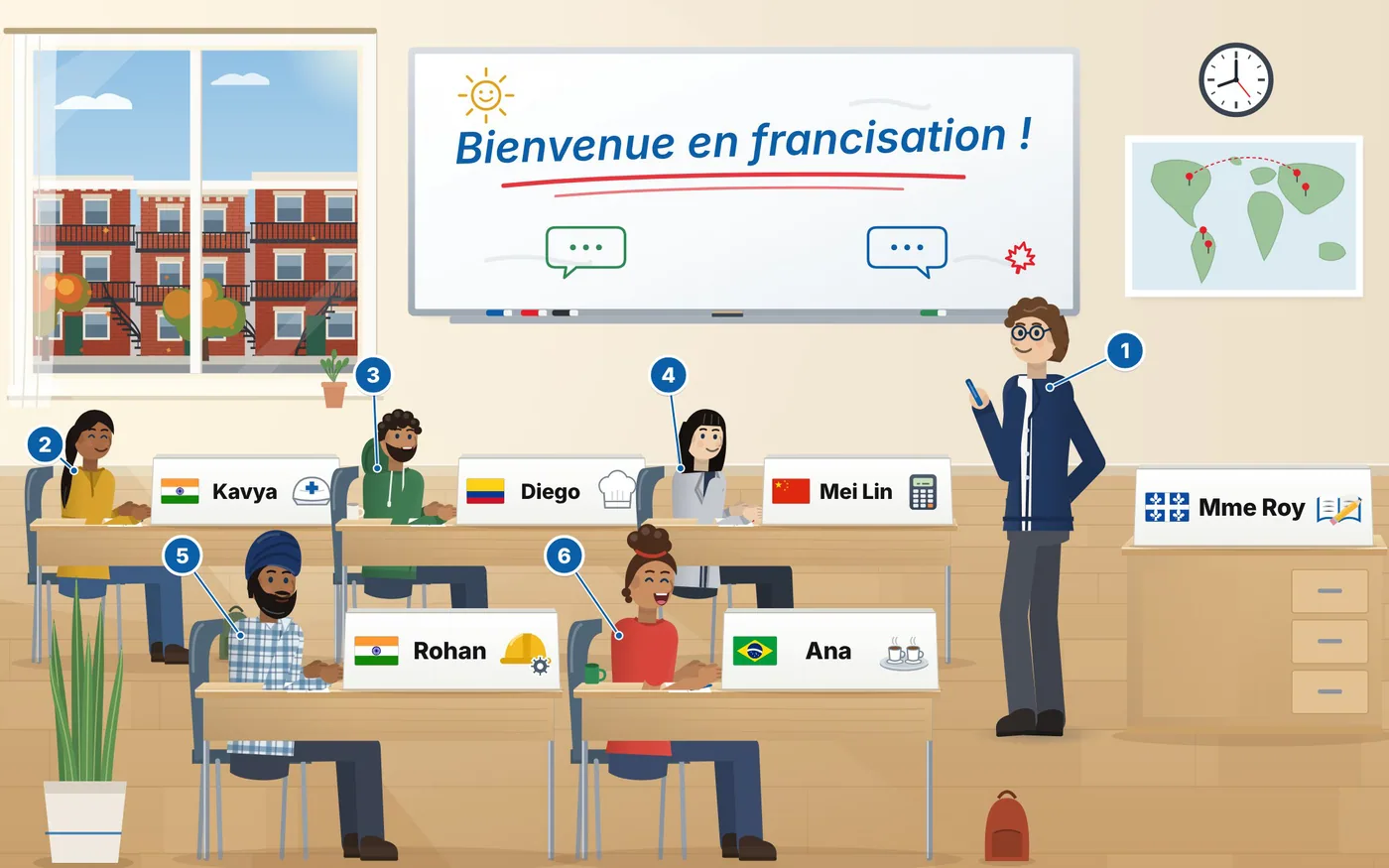
Exercise 20 Qui est-ce ?
For each person (1–6), say three sentences: name, nationality, job. Then test a partner: « Numéro 4, elle s'appelle comment ? »
MODEL ANSWER
Numéro 3 ? Il s'appelle Diego. Il est colombien. Il est cuisinier.
(11 words)
Exercise 21 Role-play: first day of class
About 1 minute
With a partner (or record both parts yourself). Part 1: meet Mme Roy (vous). Part 2: meet a classmate at the break (tu, after « On se dit tu ? »).
- Greet the person and give your name.
- Spell your name when you are asked.
- Say your nationality, your city and your job.
- Ask the other person the same questions.
- Say which languages you speak.
Read the model aloud first. Notice how the questions change from vous to tu.
MODEL ANSWER
Mme Roy : Bonjour, monsieur. Vous vous appelez comment ?
Vous : Bonjour, madame. Je m'appelle Vikram Shah.
Mme Roy : Shah… Ça s'écrit comment ?
Vous : S-H-A-H.
Mme Roy : Merci. Vous êtes indien ?
Vous : Oui, je suis indien. Je suis d'Ahmedabad. Je suis comptable.
Mme Roy : Bienvenue en francisation !
Ana : Salut ! Moi, c'est Ana. On se dit tu ?
Vous : Oui, d'accord ! Moi, c'est Vikram. Enchanté ! Tu es espagnole ?
Ana : Non, je suis brésilienne. Je suis serveuse. Et toi ?
Vous : Je suis indien et je suis comptable. Je parle gujarati, hindi et anglais.
(73 words)
FLC TIP
de becomes d' before a vowel: Je suis d'Ahmedabad, Je suis d'Indore. This is elision (Unit 0). Name your own language the same way: le gujarati, le tamoul, le bengali. A woman says Enchantée and indienne.
9 · Canada in French · Le Canada en français
French in Canada
Canada has two official languages: English and French. Federal government services, from Service Canada offices to passport forms, are offered in both, and you will see the two languages side by side on most food packages and federal signs across the country.
French is spoken across Canada, especially in:
- Québec is the heart of French-speaking Canada. French is the official language of the province and the language of work, school and daily life for most people. In Montréal, a very international city, you hear many languages, but French is the common one.
- New Brunswick (le Nouveau-Brunswick) is the only officially bilingual province, home to the Acadians, a French-speaking people with their own history, flag and accent. Kavya's friend Priya lives there, in Moncton.
- Ontario has a large French-speaking community (the Franco-Ontariens), especially in Ottawa and the east and north.
- Manitoba has a historic French-speaking community, centred in Saint-Boniface, a district of Winnipeg.
✦ LE CANADA EN FRANÇAIS
How do people greet each other in Québec? At a first meeting, at work or in class, a smile and Bonjour !, often with a handshake. Among friends and family, many Quebecers give la bise, a light kiss on each cheek; let the other person start. Say Bonjour when you enter a shop or office and Merci, bonne journée ! (Thank you, have a good day!) when you leave: skipping the greeting can sound rude.
In downtown Montréal, shop staff often say « Bonjour-hi ! », inviting you to choose the language. Answer Bonjour ! and the conversation continues in French: perfect practice.
⚜ AU QUÉBEC
You will hear Allô ! used as a friendly "hi" in Québec, not only on the phone. You may also hear Bonjour ! when someone leaves, meaning "have a good day". Recognise both, but in class and in tests use Bonjour to greet and Au revoir to leave.
10 · Self-check · Bilan
Tick each line you are sure of. If not, revise the section in brackets.
- I can say hello, welcome someone and say goodbye, formally and informally. (1, 3.3)
- I can say my name and ask someone's name with tu and with vous. (2.1, 3.3)
- I can spell my name aloud with the French alphabet. (4.2)
- I can say my nationality, my city and the languages I speak. (2.2, 2.3)
- I can say my job, with the right masculine or feminine form and no article. (2.4, 3.4)
- I can use all the forms of être and the subject pronouns. (3.1, 3.2)
Exercise 22 Quick quiz
Answer all 14 questions, then check with the key. 12 or more correct: you are ready for Unit 2.
- Je indienne. (être)
- Nous à Montréal. (être)
- Ils comptables. (être)
- Il est cuisinier. → Elle est .
- Il est colombien. → Elle est .
- To your teacher: « êtes québécoise ? »
- To a child: « t'appelles comment ? »
- Correct the mistake: « Elle est une médecin. »
- Kavya, Diego and Rohan are in class together: « sont en classe. »
- Translate: My name is Rohan.
- Translate (a woman speaking): I'm a nurse.
- Translate (to a man you don't know): Are you Indian?
- Translate: I speak Hindi and a little French.
- Which Canadian province is officially bilingual?